




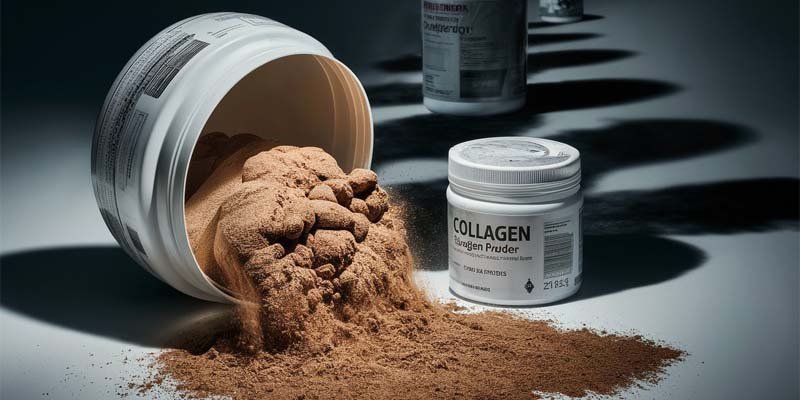
It sits at the back of the pantry shelf — a tub of collagen powder purchased during a health kick several months ago, used inconsistently, and now carrying a printed date that may or may not have passed. The question that follows is one that a surprising number of daily supplement users have never properly resolved: can collagen powder expire in a way that actually matters — for safety, for efficacy, or for both? The answer is more nuanced than a yes or no, and understanding it properly changes the way thoughtful supplement users approach everything from storage habits to purchase decisions to the moment they decide whether to use or discard a product whose date has come and gone.
What the Date on the Label Actually Represents
The printed date on a collagen powder product is one of the most consistently misunderstood pieces of information on a supplement label — and that misunderstanding leads to two opposing errors that are both worth correcting.
The first error is treating the printed date as a safety cutoff — the moment at which a product becomes dangerous and must be discarded regardless of its actual condition. This interpretation causes supplement users to discard products that remain fully effective and entirely safe, creating unnecessary waste and replacement cost without a corresponding safety benefit.
The second error is treating the printed date as irrelevant — the manufacturer’s conservative estimate of a product that will remain effective indefinitely. This interpretation leads supplement users to consume products that have meaningfully degraded in potency or, in cases of poor storage, developed quality issues that affect both safety and efficacy.
The accurate understanding sits between these two positions. The date printed on most collagen powder products is a best by date — a manufacturer’s representation of the period during which the product can be expected to deliver its full labelled potency under appropriate storage conditions. It is a quality and efficacy statement, not a binary safety indicator. Products consumed within a reasonable period after a best by date under good storage conditions are in most cases safe but may be delivering reduced potency. Products stored poorly — exposed to moisture, heat, or contamination — may develop genuine quality issues before the printed date is reached.
The Chemistry of Collagen Powder and Why It Ages the Way It Does
Understanding why collagen powder expires at the rate it does — slower than most supplement users assume, faster than truly shelf-stable foods — requires a brief understanding of what collagen powder actually is at a chemical level.
Collagen peptides are hydrolysed protein fragments — chains of amino acids produced by breaking down the collagen from bovine, marine, or porcine sources through an enzymatic or thermal hydrolysis process. The hydrolysis process produces short-chain peptides that are water-soluble, easily digested, and — critically for shelf life purposes — inherently more stable than the intact collagen protein from which they are derived.
The primary degradation mechanisms that affect collagen powder over time are oxidation of the amino acid chains, moisture-induced microbial activity, and the Maillard reaction — a chemical process between amino acids and residual sugars that produces browning, off-flavours, and gradual amino acid degradation. All three mechanisms are significantly slowed by the conditions that best by dates are calibrated for: low moisture, cool temperatures, darkness, and the absence of oxygen in a sealed container.
This chemistry explains why collagen powder stored correctly degrades slowly — and why the same product stored poorly can reach genuine quality compromise well before its printed date. The date on the label is not a fixed property of the product. It is a representation of expected quality trajectory under specific storage conditions that the manufacturer assumes but cannot guarantee the consumer will maintain.
The Storage Conditions That Determine Whether the Date Matters
The gap between a collagen powder that remains effective and high quality well beyond its printed date and one that degrades significantly before that date is almost entirely explained by storage conditions rather than by any intrinsic property of the product itself.
Moisture is the most consequential storage variable. Collagen powder in its dry form is stable — the low water activity of a properly manufactured and sealed powder product creates an environment in which microbial growth and the hydrolytic degradation of amino acid chains are both severely limited. The introduction of moisture — through condensation from temperature cycling, a wet measuring spoon, or the ambient humidity of a warm, damp storage environment — changes that equation rapidly. Even small amounts of moisture introduced into a collagen powder container create localised conditions that support microbial activity and accelerate amino acid degradation in ways that compound across subsequent storage weeks and months.
Temperature management is the second critical variable. Collagen powder does not require refrigeration under normal storage conditions — but sustained exposure to high ambient temperatures accelerates the oxidative degradation and Maillard reaction processes that reduce potency and produce off-flavours over time. A pantry at consistent room temperature is appropriate. A shelf above a stove, in a car, or in a storage area subject to significant temperature variation is not — and the accelerated degradation in those conditions will express itself as a product that reaches functional end of life well before its printed date.
Container integrity is the third variable. A container that seals completely between uses — eliminating oxygen exposure and preventing moisture entry — maintains the internal environment that slows all three primary degradation mechanisms. A container whose seal has been compromised, or that is repeatedly opened without reclosing securely, introduces the oxygen and moisture that accelerate degradation regardless of the external storage conditions surrounding it.
How to Evaluate a Collagen Powder That Has Passed Its Printed Date
For supplement users facing the practical decision of whether to use or discard a collagen powder product whose printed date has passed, a sensory evaluation provides more meaningful information than the date alone.
Smell is the most reliable initial indicator. Fresh collagen peptides are nearly odourless — a very mild, neutral scent at most. A sour, rancid, or sharp smell indicates oxidative degradation or microbial activity that warrants discarding the product regardless of how recently the date passed or how carefully it was stored.
Texture and appearance provide secondary indicators. Some clumping in collagen powder is normal — particularly in humid environments — and does not necessarily indicate quality compromise. Heavy clumping that has hardened into solid masses, significant colour change beyond light yellowing, or visible mould growth are all unambiguous indicators that the product should be discarded.
Taste, for users willing to evaluate it, provides the most sensitive indicator of degradation-related quality change. An off, bitter, or rancid flavour that was not present when the product was fresh indicates amino acid degradation or oxidative rancidity that affects both quality and the user experience of consuming the product in food and beverage applications.
A product that passes all three sensory checks after its best by date has passed is in most cases safe to consume — though some degree of potency reduction relative to the labelled specification should be expected as a function of time elapsed and storage conditions experienced.
Why Quality From the Start Determines Everything That Follows
The shelf life conversation ultimately leads back to a more foundational question about product quality — because the starting point of a collagen powder’s quality trajectory determines how much of that quality remains at any given point in its storage life.
A product manufactured to high standards — precise hydrolysis to consistent peptide molecular weight, low moisture content at packaging, appropriate antioxidant stabilisation where relevant, and packaging that genuinely seals and protects — begins its shelf life at a higher quality point and degrades more slowly than a product manufactured to lower standards. The best by date is calibrated to the expected trajectory of a specific product under specific conditions — which means that two products with identical printed dates may reach that date with very different remaining quality depending on the manufacturing and packaging standards behind them.
BioOptimal Supplements approaches collagen powder formulation and packaging with this principle as a foundational quality standard — producing a product whose quality trajectory from manufacturing through to the end of its shelf life reflects the investment that daily supplement users are making in their long-term health and wellness routine.